
If the rig fits, the job is buildable. We size that answer before you bid it.
Limited-Access & Low-Headroom Drilling
ESC drills anchors, micropiles, and tiebacks where a conventional track rig cannot stand — restricted headroom, no crane, no lay-down area, tight urban footprints. The scope is drilled with a compact, crawler-mounted, articulated-mast rig; the Klemm KR 806-3GS is the reference machine the dimensions on this page are taken from, and the rig configured for your job is confirmed against your measured clearances. Before a GC prices the scope, we walk the access route, because a fit that only works on paper is a change order.
Typical spec
Plain-language view of the same typical ranges.
- Drill transport width (KR 806-3GS)
- ≈ 2,500 mm / 8 ft 2 in
- A typical range for this kind of work.Typical value — confirm against the project's geotechnical design.
- Drill transport height (KR 806-3GS)
- ≈ 2,950 mm / 9 ft 8 in
- A typical range for this kind of work.Typical value — confirm against the project's geotechnical design.
- Drill operating weight
- ≈ 19.5–19.7 t
- A typical range for this kind of work.Typical value — confirm against the project's geotechnical design.
- Minimum working headroom
- Confirm per mast configuration(pending)
- A typical range for this kind of work.Typical value — confirm against the project's geotechnical design.
- Minimum access opening
- Confirmed on site walk(pending)
- A typical range for this kind of work.Typical value — confirm against the project's geotechnical design.
- Adjacency method
- Rotary / rotary-percussive drilling
- A typical range for this kind of work.Typical value — confirm against the project's geotechnical design.
How it goes in
- 01
Survey the access route
We measure the whole path, not just the room: door and gate widths, corridor turns, ramp grades, slab and deck capacity, and the slab-to-slab clear height at every point the rig must pass and stand.
- 02
Configure the rig to the constraint
Mast, drill string segment length, and power pack placement are selected for the measured headroom and reach envelope. Where clearance rules out the standard mast, the mast configuration changes — not the clearance we quoted.
- 03
Protect what's standing next to it
Rotary and rotary-percussive drilling is used in place of driving or impact where adjacency demands it. Access protection, dust and spoil control, and work-hour sequencing are set with the GC to suit how the structure is being used.
- 04
Drill, install, and grout
Holes are drilled to the design depth and inclination, steel is installed, and the bond zone is grouted per the PE-stamped design. Installation records are logged hole by hole for the engineer of record.
Equipment on this work
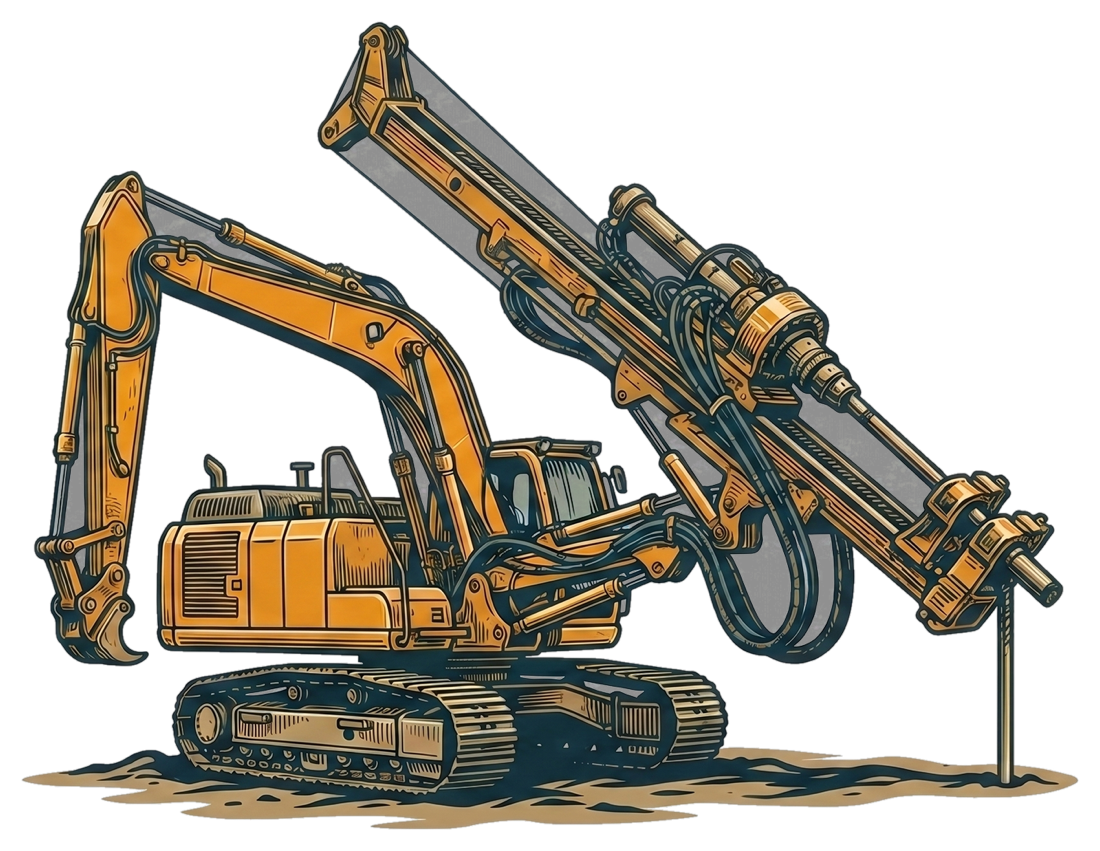
Klemm KR 806-3GS
Limited-access anchor & micropile drill
Configures to the access constraint and drills from inside the building.
Equipment shown as illustrative renderings.
Where it fits
- Restricted-headroom drilling under decks, canopies, and low overhead
- Work points a standard track rig cannot be driven to or set up on
- Underpinning and micropile scopes with no lay-down yard beside them
- Low-vibration work adjacent to historic and masonry abutters
- Sites with no crane access, restricted overhead, or tight urban footprints
- Interior and basement scopes, priced off a site walk and a measured access route
Frequently asked
Ready to scope your foundation?
Tell us about the project and we'll put together a detailed quote within 3 days. We generally work with general contractors.
Or email plans to bids@earthsupportcorp.com